
Solution Explorer
Solution Explorer
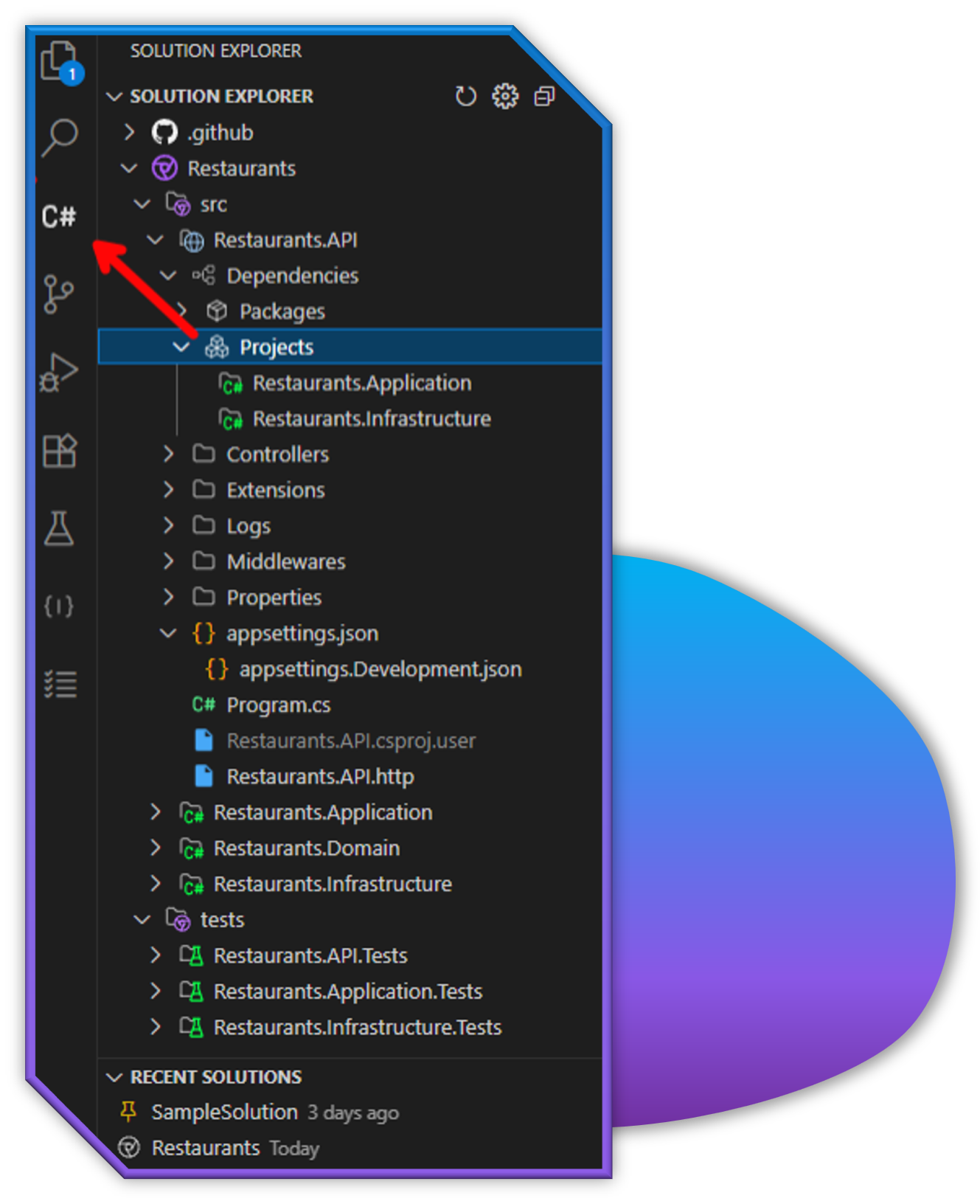
The Solution Explorer is a core feature of C# Dev Tools, providing a Visual Studio-like experience for managing .NET projects.
Overview
Section titled “Overview”The Solution Explorer gives you a complete hierarchical view of your .NET solution, including:
- Solution files and properties
- Projects and project references
- Solution folders
- File system folders and files
- Dependencies (NuGet packages and project references)
Key Features
Section titled “Key Features”The Solution Explorer provides a comprehensive set of features organized into the following areas:
- Opening Solutions - Load and manage .sln and .slnx files
- Creating New Projects - Generate new projects from templates
- Adding Existing Projects - Import existing projects into your solution
- Multi-root Workspace Support - Work with multiple solutions simultaneously
- Running and Debugging - Build, run, and debug your applications
Basic Navigation
Section titled “Basic Navigation”- Expand/Collapse: Click the arrow icons to expand or collapse items
- Open Files: Double-click on a file to open it in the editor
- Select Multiple Items: Use Ctrl+Click or Shift+Click to select multiple items
- Context Menu: Right-click on items to see available actions
Advanced Features
Section titled “Advanced Features”File Path Operations
Section titled “File Path Operations”Right-click on an item and select:
- Copy Path: Copy the full path to the clipboard
- Copy Relative Path: Copy the path relative to the workspace
- Reveal in File Explorer: Open the item’s location in File Explorer
- Open in Integrated Terminal: Open a terminal at the item’s location
Active File Tracking
Section titled “Active File Tracking”The Solution Explorer can automatically highlight the currently active file:
- Open VS Code settings
- Search for “csharp-dev-tools.solutionViewer.trackActiveFile”
- Toggle the setting as desired
You can also press Shift+Alt+L to reveal the current file in the Solution Explorer at any time.
File Exclusion (files.exclude)
Section titled “File Exclusion (files.exclude)”The Solution Explorer respects VS Code’s files.exclude setting from both workspace and user (global) configurations:
- Files matching exclusion patterns are automatically hidden from the tree
- Glob patterns are supported (
**/*.ext,folder/,**/folder/**, …) - Workspace settings override user settings, allowing fine-grained control per project
Automatic IDE Files Exclusion
Section titled “Automatic IDE Files Exclusion”When a .NET project is detected (by the presence of .sln, .slnx, or .csproj files) the Solution Explorer automatically hides IDE-generated files:
- Visual Studio user files:
*.csproj.user,*.user,*.suo - Visual Studio directory:
.vs/ - JetBrains Rider directory and settings:
.idea/,*.DotSettings.user
You can override this behavior via your own files.exclude settings if you need to see those files.
Unity Project Support
Section titled “Unity Project Support”Unity projects are automatically detected (presence of Assets/, ProjectSettings/, or Unity references in .csproj files) and:
- All
*.metafiles are hidden from the Solution Explorer - Moving or renaming files in Unity projects automatically moves/renames the associated
.metafiles alongside them, keeping Unity’s asset metadata in sync